Thursday, 4 January 2018

Risk Assessment of Location

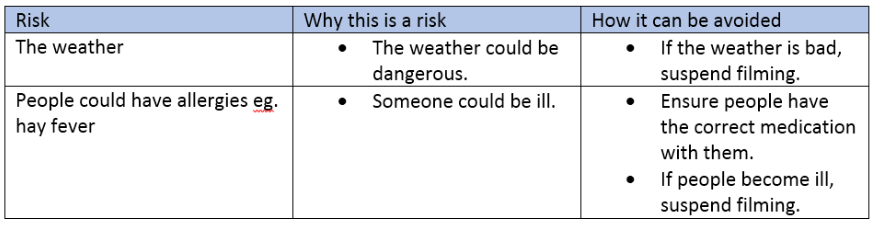
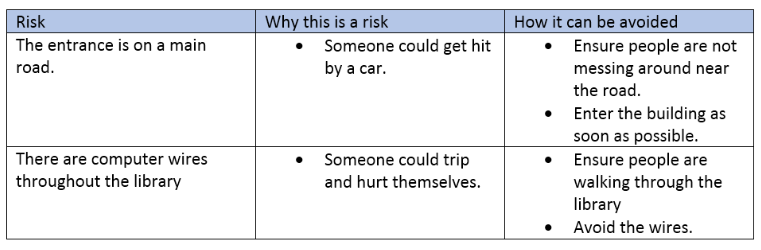
To ensure that my group and the actors/actresses we will be using are safe throughout the filming process, I decided to do a risk assessment of the three main locations we will be filming at. This enable us all to be safe and ensure we carry out the filming at a professional standard.

Location one: Altrincham car park


Location Two: The library


Location Two: The library


Due to there being numerous locations in Altrincham, I cannot cover every risk. Instead, when I am filming, I will ensure that everyone is safe and if any issues do come up, I will handle them carefully and professionally. 

Location Decisions

When trying to decide on a location to film our narrative we decided to film in a separate location for the live performance and the narrative performance. This is because it conformed to previous music videos we have analysed. We also decided that to get the best opinion of which location would be best, we would take the props we were going to use in final recording and the artist would dress up in the costume we had planned for the real filming. This is because it would allow us to visualise more effectively what each location would look like in the frame and footage. 

For the live performance we decided to try and find somewhere outside to film. This is because, when I researched codes and conventions of locations for female indie artists, many were outside in natural areas. However, we wanted to challenge this and try and find a more industrial area to create a more ‘edgy’ and ‘grunge’ tone to the live performance. 

Originally we had the idea of filming outside with candles to incorporate the idea from Lorde’s live performance video of ‘Sober’. However, because of the time of year, we realised that the weather wouldn’t be suitable. We also don’t have a camera of high enough quality to create a focus on the artist and a shallow focus on the candles. This therefore, would have washed out the artist. This is why we came up with the industrial idea as it allowed us to still create an edgy aspect to the live performance but it was something that was practically with the equipment we had. 

Therefore, when we were trying to find a location, we found two places that conformed to our vision; a roof top in a town centre, and a car park loading bay. Both of these location featured a lot of brick reds and metallic surfaces all of which created mysterious and dark tones. 


The location we decided to use was the roof top as it had a natural open sky in the background and a skyline. We also thought that if we filmed at sunset we would have a nice orangey/red sky in the background that could connote the passion and love within our narrative performance. 


For the narrative performance, we decided not to plan any specific locations for the red thread theory. Instead we would improvise in the locations on the day to make it seem more natural with the characters we used as they had no acting experience. The library scene we knew we would film in our local library and the rest of the narrative would be filmed in our groups houses which were available on the day. This meant we could organise the props within the house according to how we wanted.

Wednesday, 3 January 2018

Talent Release

To ensure the people acting in our music video give us permission to allow us to publish the music video online, we asked them to fill out a talent release form. This ensures that our music video will be professionally distributed and ensure it won’t be removed once published.


Although we will feature other people within our music video, their full identity will not be shown and we will not use their voices within the video. Their screen time within the video will only be a maximum of three seconds so they will not need to fill out a talent release form.

Monday, 1 January 2018

Casting Updates

Due to having problems with our actress who were meant to be casted as both the artist and as part of the narrative performance, we decided to change our casting choices. Instead of using Emily as our artist, we decided to use Liv Mclean who is a member of our group.


We also decided to swap the male character and other female character within our narrative to two of our friends as they were more available on the days we were planning to film. Although they have no acting experience, they are both attractive people and fit the brief for the characters we wanted in our narrative.

Lauren is an art student and although she has no acting experience, her creativity meant that we were sure she would understand our vision for our end product.


Callum is a fellow media student so we were confident he would understand the need to be efficient whilst filming and would be able to take our directions well as he has experience in directing.


We also asked them to sign new talent release forms to ensure we could use their footage within our video and share it publicly. 

Tuesday, 26 December 2017

Storyboard Two: Narrative Performance

After creating the storyboard for the red thread, we created the narrative performance storyboard as a group. This meant we are all aware of the micro aspects of filming which will ensure we still have a great understanding of what we’re filming/ how were filming if someone can’t make one of the filming sessions.


Thursday, 21 December 2017

Ancillary Task: Lana Del Rey Digipack

As Lorde has never created a digipack, we cannot use her existing material as inspiration for our products. Therefore, I decided to look at Lana Del Rey’s existing material as she has the same target audience as Lorde, she is also female and creates content that conforms to the indie genre. Therefore, I decided to look at her digipacks.

The first digipack she created was for ‘Lust for Life’ the album. This album was released in July 2017. The digipack cover she created featured her iconic font saying ‘Lana Del Rey’ and the title of the album: ‘Just life’ with the parental advisory sticker in the corner. Although this sticker could be placed on the back of the album, it would appeal to her target audience of aspirers who aspire to be different and in some senses, rebel.


The key image featured on the cover of the digipack features her foregrounded against a car. The use of herself as the key image utilises celebrity endorsement to appeal to those who are also outside her target audience through her recognisable style and image (conforming to Dyer’s Star Theory). The white boarder around the image conforms to the 1950’2 retro styles that is consistently featured through her brand identity. This is continued in the iconic hairstyle and bold red lipstick she is wearing which again helps to appeal to her target audience; her iconic brand identity.


The theme of the front cover is continued through the rest of the digipack. The flower that can be seen in her hair on the front cover is further seen in the key images of the rest of the digipack. The white flower has connotations that can be linked to the songs and lyrics that are featured on the album; ‘White Mustang’ (song), ‘Wilting like a rose’ (lyric), ‘blooming’ (lyric). The use of a white filter on top of the images also continues the theme of the flower. This creates a consistency throughout her digipack.


Another feature of the digipack was the back cover that featured the names of the songs within the album. The red font that is consistent with her iconography in general and throughout the digipack is used to write the names of the songs. This challenges typical layout of the song titles of the digipack as they are typically written as one line per column. However, in this case, she has written them as a continuous line with dashes used to separate them. The key image is again consistent with the theme of the digipack, featuring the white flowers and the same location, costume and makeup  is used as that of the key image on the front cover.

How can this help me?
Overall, analysing Lorde’s digipack has taught me that the consistency of a theme throughout the product is significant. It is also effective to have props/features in the key images (in this case the white flowers) that has a symbolic meaning related to the artist/their songs. This is especially important when you have an indie audience as they will gain psychological rewards when they realise the symbolic meaning; it confirms their knowledge of the artist and strengthens their loyalty.

Storyboard One: Red Thread Theory

To help me plan my filming, I decided to create a storyboard for the first section. This is the part of the narrative where the theory of the red string is established. I decided it would be useful to split the filming into three key stages: live performance, establishing the red thread and the rest of the narrative performance. This will allow us to make more precise storyboards. This will also be useful as we plan to film each section on separate days which will allow us to concentrate in more depth on each section.